Northern Cardinals
Identification and Pictures
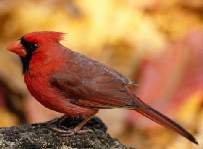
(Richmondena cardinalis), name changed from Cardinalis cardinalis in 1918.Male Northern cardinals
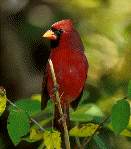
are all red with
the exception of the black patch around their thick
triangular or conical bill. Their bright color, and the pointed
crest make them instantly identifiable by bird
enthusiasts. They keep this bright red plumage year
round, and it is very striking in snow.
photo by Hollingsworth us
Wildlife
|
 |
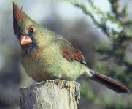
| The female is brownish with some red on the wings, and
tail. Just like the male, the female has a dark face,
and heavy red bill, good
for eating seeds. Adults are 7 ½ to 9 inches.
Young birds look much like
the female, with darker bills. |
by Menke, Dave US Wildlife |
At one time cardinals were kept as caged pets,
but the Migratory Bird Treaty Act of 1918 banned the practice
in the U.S.
Sound
Cardinals have several variations of repeated whistles (whe-cheer-cheer
or whertee-whertee-wherte). A contact or alarm call
sounds like chip. Female cardinals sing while they are
on their nest. A pair will have song phrases they share.
Cardinal song Click to hear Sound
Range and Habitat
The Northern cardinal is a year round resident of the eastern U.S.,
and continues to spread north. It is so well liked that more
states have adopted it as their state
bird than any other bird. These states are: Illinois,
Indiana, Kentucky, North Carolina, Ohio, Virginia, and West
Virginia.
They like the edges of wooded areas, river
thickets, and gardens. You can find them in areas near
people such as parks, and backyards.
Nesting and Breeding
Breeding season begins in late March to early April.
Cardinals will breed in a wide variety of areas.
Once he develops a territory the male
cardinals will aggressively defend it. They have been known
to attack their reflections in windows, mistaking them for
other males.
The male feeds the female during courtship. Cardinals will mate for life, and remain together throughout
the entire year.
The male usually follows the female as she
searches for a nest site. They carry nesting material in
their beaks, as they call back and forth to each other. They prefer to build their nest in shrubbery
or a thickly branched tree. Males may bring nesting
material to the female, who will build a cup
shaped nest in 3 to 9 days.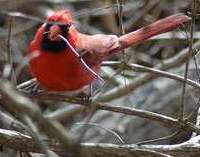 Nesting
materials are twigs, weeds, and grasses, bark fibers, dead
leaves, moss, rags, and other debris. Nesting
materials are twigs, weeds, and grasses, bark fibers, dead
leaves, moss, rags, and other debris.

The female will lay between two, and five white or
greenish eggs with dark streaks, and spots on them. Usually
the female will incubate the eggs for 11 to 13 days. The
young will be fed by both parents for around 10 days, and will
be able to fly well in about 20 days.
Two, three, or four broods may be raised in a breeding season.
The male will tend the brood while the female starts the next
brood.
Feeders and Food
Natural foods
In the wild, Cardinals eat fruit, seed, and insects. Their
heavy conical bills allow them to eat a wider range of seeds
than birds with smaller bills such as sparrows or
finches.
They search from the ground for food and can
be heard foraging in bushes when they are out of sight. As
they hop around they will scratch the ground with both feet
searching for insects and other food.
Attracting Cardinals to your
Backyard
Because Cardinals are not migratory you can attract them
to your yard all year long with feeders, water, and shrubs. Many kinds of shrubs and trees will attract
them to your yard. Some are, blueberry, cherry, dogwood,
mulberry sumac.
In addition to eating any fruit these may provide, they may
nest and raise their young in the dense shrubs.
Get a Cardinal puzzle.
Feeders
If you put out feeders they will eat almost any kind of fruit,
and seeds you offer them. Good food choices are cracked corn,
millet, bread, nutmeats, safflower, peanut butter mixes, and
suet. A favorite is un-hulled black-oil sunflower seeds.
If you watch them at the feeder you will see them touch beaks
as they offer each other seeds.
Water
In addition to food; provide a source of water for drinking
and bathing. Many birds will come to clean their feathers in a birdbath.
Running or dripping water will also attract them. Birds love
to bathe in a slow sprinkler.
For more on food
and feeding click here.
For more on feeders click here.
To learn about other favorite
birds click here.

|



 baths, feeders
and more...
baths, feeders
and more...