American Goldfinch

Identification and Pictures
(Carduelis tristis)
The American Goldfinch is a small finch about
5 inches. Its thick conical bill
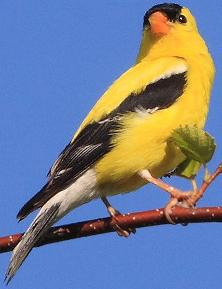
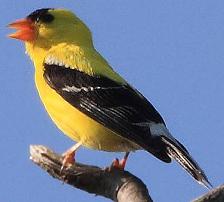
is good for eating seeds. In summer the male is bright
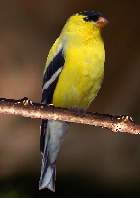
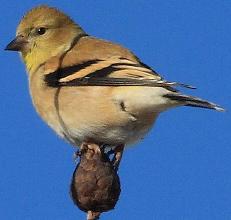
yellow, with black wings, tail, and forehead patch. The female
is a duller olive-yellow with black wings.
In the winter they both look more like the
female but a little duller. Its flight is undulating, often
with a chirp with each dip.
Song of American Goldfinch
In spring, and summer during nesting males
can be heard giving their high pitched canary-like
song. Their song is a series of random sounds,
clear, and light, like per-chek-oree.
Some say it sounds like pot-tato-chip. As they fly
each dip in their undulating flight is punctuated by
tee-dee-de-dee.
|
 |
American Goldfinch song Click
for Sound
American Goldfinch Habitat
Their natural habitat is woodland
edges, thickets, and weedy patches. They can be seen in open
woods, on lawns, and on roadsides. They forage in large
flocks. It is fun to watch flocks fly with their roller
coaster manner. They range from south Canada through the
U.S. to north Mexico
Breeding and Nesting
Breeding season begins in April or may in the
southwest to mid June in the east. Goldfinches like to breed
in areas with openings among trees, and shrubs.
The female usually builds a well made nest, in high
weeds, or in a tree or shrub, often near water. The nest is
firm and compact made of strips of bark, catkins, plant down,
cotton, spider webs, and wood. The male will feed the female
while she incubates 4 to 6 eggs. The eggs are smooth and pale blue, or
greenish-blue, slightly glossy. Young birds are tended by
both parents, and will leave the nest in 10 to 17 days.
Feeders and Food
Goldfiches eat mostly seeds. They also
eat insects, tree buds, and maple syrup. They are active
feeders climbing around in weeds, trees, and shrubs. Feeders with thistle, and other seeds will
attract them. Make sure you also provide water.
For more on food
and feeding click here.
For more on feeders click here.
To learn about other favorite
birds click here.

|



 baths, feeders
and more...
baths, feeders
and more...