No matter where we live, the songs of birds brighten up our
days. This is nature’s orchestra at its best. The
early morning chirps of a robin or chickadee delight us, and
the sound of a honking flock of migrating geese inspire us.
There is an incredible diversity. Some birds have their
songs encoded at birth, while others learn their songs, either
from their father, or from birds around them. Some of
those that learn their songs only learn when they are young,
and others keep learning their entire life. Some species
may sing the same song but have different dialects from one
area to another. Some birds such as the Brown thrasher,
may have hundreds or thousands of different songs, while
others such as the Common Yellowthroat, may have as little as
one.
While bird watching is enjoyable, learning the songs and calls
of birds adds an exciting dimension to it. Being able to
identify unseen birds from a distance, when they are hidden in
the bush or a wooded habitat, by listening to their songs and
calls is very satisfying. Many people do what is called
spishing, where they make a (spis) sound with their
lips. Another technique is kissing the back of your hand
to make a squeaking sound. Some songbirds such as chickadees
and warblers will come to check out
the sound.
A Bit of History
The first record of bird song recording was by Ludwig Koch in
1889. At the time Ludwig was eight years old. He recorded the
Indian Shama, a member of the Thrush family. Many years later
after Dr. Koch moved to Britain from Germany he worked with
E.M Nicholson. E.M Nicholson became the director of the
Nature Conservancy creating the book “Songs of Wild Birds.
Dr. Koch’s sound recordings became the base for the BBC’s
natural history library. As you can imagine the
recording equipment at that time was very cumbersome.
Communication of Bird Songs and Calls
Songs and calls play a very important role in the live of
birds. With all the ways birds communicate sound is probably the
most important. Because birds do not have a strong sense of smell they
rely on vision and sound. Sound is ideal for low light or
over long distances.
Basic Difference between Songs and Calls
Songs
Songs are more musical, and complex then calls. Songs are usually only produced by the male.
Males often learn these songs from their dads or by listening to nearby males. Because they learn these musical phrases regional dialects are often developed. A male’s song may get richer, and more varied as he gets more experience with age. This gives him a bit of an edge over younger birds. When the female chooses a mate she will evaluate his health and maturity by this song.
With most birds the
song can be associated with breeding. The male is singing to
find or communicate with his mate and to claim and protect his
territory by warning other males to stay away. Social
bonding of pairs may also be aided with songs.
The majority of the singing is in early morning. The
birds will be quiet during the middle of the day, and start up
again in late afternoon, although there are some species that
will sing all day long.
Song birds such as warblers may have different songs for
attracting mates than they do for protecting their territory. Some birds
such as Meadow larks will do a duet where each partner contributes
phrases to the song. A male Red-winged blackbirds will
sing while the female chatters back
at him.
Male songbirds may do what is known as countersinging during territorial disputes. In this contest each bird will
match the other bird's song types. One bird famous for this
is the Marsh wren.
Some songbirds are known for imitating the sounds of other
birds and animals. Mockingbirds
will even imitate machinery. European starlings,
catbirds, and thrashers are imitators. Blue
Jays will imitate the call of a hawk. There are two
types of songs. The loud primary song we usually hear a
male singing, and soft songs that are called whisper song.
Calls
Calls are usually not as musical as songs. They are
usually only a few short notes, and may be heard throughout
the year. Birds use calls to
communicate many things to each other, and between members of
a flock or family. Contact calls may be used to give
others information such as a birds location. There are calls for aggression, warning,
identification, flocking, hunger, to announce a food source,
and many others. Many species will have calls that specify a
certain type of predator in the area.Some calls are understood by more than one
species. A recent fascinating study by scientists at the
Universities of Washington, and Montana found that nuthatches
understand chickadee calls. When chickadees warn that
predatory bird is near, the nuthatches will band together with
them to surround the predator in an attempt to drive it away.
Young birds give begging calls to get their parents to feed
them.
Although calls are used for communication, that communication
is in the present. Here is an example of what I mean. You may
tell a friend you left your keys at his house yesterday.
Birds have not developed the mental capacity for this, and
can only communicate something happening right now such as a
warning call.
Learning to Recognize Bird Sounds
Many people buy tapes or CDs of bird sounds, both for
enjoyment and, to learn the different songs.
You can also search sounds from web sites such as
FindSounds.com. Many of these can be downloaded for your
own use. Some people like to record sounds themselves.
Bird sound recording equipment can be found on the Internet.
The more ways you have to identify a bird the more you
will enjoy, and the more success you will have at bird
watching.
Their colorful plumage makes most birds easy to identify if
you can get a good look at them. If the birds are in the
brush, a long distance away, or in poor light it is more
difficult. Because of the effects of shadows, lighting,
and changes in plumage, visual identification is often not as
reliable as identification from songs and calls. Many bird watchers learn to identify bird shapes and silhouettes as
well as sounds.
The best place to start learning birdcalls is in your back
yard. If you walk through a wooded area there may be such a
stream of different calls it is hard to pick one out. By
observing the birds in your back yard, and listening to their
calls, you can learn to pick them out in a forest or wooded
area. This combined with their shapes can make your birding
experience more fun and rewarding.
In addition to listening to them in your back yard there are
many tapes of birdcalls you can buy. You can also find sounds online for almost
any bird.
Sound Production
Birds have a sound-producing organ called the syrnx. The
syrnix is near the bottom of their windpipe, where it divides
into the main bronchial tubes that lead to the lungs. The
membranes are like the skin of a drum, and vibrate as air is
pushed out through them. Pairs of muscles control the tension
on the membranes to change the sound characteristics. The
number and complexity of these muscles vary with different
species, and if fact between male and female. The syrnix
is divided into two compartments, one for each lung.
These can be controlled separately, and sounds from each can
be combined. This is why birds such as starlings, and
mockingbirds can make such varied sounds, and are such good
imitators.
Birds Hearing is also Important.
Their hearing is much the same as ours. One big advantage is
that they have developed sense of time resolution, which is
about 10 times better than ours. What does this mean? Several
separate notes in sequence may sound to us like one long
note. Because of their time resolution ability they hear the
note separated into the smaller segments. This allows more
information to be communicated. One way to visualize this is
to compare it to a piece of movie film. When run through a
projector we can’t see the separation. Scientists today use
sound spectrographs to study these.
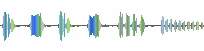
Below is both the sound and visual image of a simple robin
chirp. It sounds to us like two notes. In the
image you can see the separation that birds can hear. Hear Robin Chirp If your browser will not let
you use this sound link, the Robin Chirp is the last on in the drop
down list below.
Other sounds
There of course sounds other than songs or calls. Here are
a few:
Drumming of a Woodpecker
Woodpeckers have specialized bills, and neck
muscles for hammering on tree trunks. In addition to drilling
holes they use this to send sound signals. Woodpeckers and grouse both use
drumming to claim a territory, and attract a mate, just like
songbirds use their song. Grouse beat their wings to make the
sound.
Note on some browsers you will not be able to see or use the
drop down sound list. If you can't use it try the sound
links below.
The Common snipe will climb high in sky then dive down at a
slant with its tail feathers spread. The air rushing through
will cause the outer feathers to vibrate creating a drumming
sound. It has been described as a siren or bleating
sound. Owls and herons snap their bills to show
aggression or if alarmed.
Most of the pages about specific birds on the All-Birds
website have samples of the particular birds song or call.
Click here for favorite birds
and their sounds.



 Bird
Sounds - Songs and Calls
Bird
Sounds - Songs and Calls
 If your browser will not let
you use this sound link, the Robin Chirp is the last on in the drop
down list below.
If your browser will not let
you use this sound link, the Robin Chirp is the last on in the drop
down list below.
