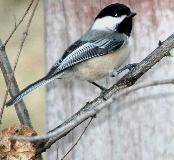
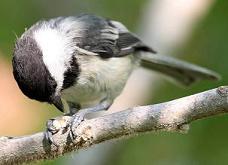
These are small fluffy round birds 4 to 5 ½
inches. They have a black cap, and bib with white cheeks. Their
upper
parts are gray with lighter under parts under parts, which may
have a bit of yellow. The sides are a buff color with white
feathers on the wings.
Photos by Keith Lee. The camera I use is
the Canon EOS
40D and a 70 to 300 zoom lens.
Some say this bird is fun to watch
because of its acrobatic nature actions as it hangs upside
down or forages through branches.
Determining male from female is hard as indicated in this poem
by a Wisconsin bird bander.
"Here’s to the little chickadee;
The sexes are alike, you see.
It’s hard to tell the she from he;
But he can tell … and so can she!"
Harold Wilson
Range and Habitat
There are 10 chickadee species in North
America and Black- capped chickadees are the most familiar in our backyards. They can be found throughout the northern
U.S., Canada, and Alaska. They like open woods, willow
thickets, groves, parks with shade trees, farmlands, and
backyards with trees, and shrubs. Chickadees may be seen in
your yard all year long. In winter they will form in
foraging flocks with nuthatches, titmice, and even
woodpeckers. In late winter as the males become
territorial these flocks will break up.
Breeding and Nesting
Breeding season is early April to mid May
depending on the area. During courtship chickadees do
what is called mate feeding, females will solicit this
behavior. The male will fly to the
female with an insect or seed. With a high call, and
quivering wings she will take the offering.
They breed in forests, and open areas with scattered trees.
Both birds will excavate a nest cavity in a stump or tree.
The cavity will be around 9 inches deep, and have moss or
plant down in the base. They sometimes use an old woodpecker
hole or a nest box. If you have birdhouses in your yard
there is a good chance these entertaining little birds will
move it.
The female alone will incubate usually 6 to 8 eggs. Eggs are
smooth, white or creamy with fine purplish or reddish-brown
speckles. Both parents tend the young birds for around two
weeks, when they can leave the nest. The young will remain
with the parents for 3 to 4 weeks.
Song and Call
When chickadees are around there is a
constant chatter of clear chick-a-dee-dee-dee, this is often
given during flocking. The male's song of fee-bee-bee is
a clear whistle that sounds like feed me feed me to many
people. Researchers at the University of Montana have
discovered that chickadees have one of the most sophisticated
systems of communication of any land animal. They use a soft high-pitched seeet call to warn of something like a flying bird of prey.
For a stationary predator they use variations of chick-a dee dee dee. The number of dee dees indicate the size or type of
predator. The calls are used to warn and to recruit other birds to harass, or mob, the predator and chase it away.
Recent studies at the Universities of Washington and
Montana show that
nuthatches understand the warning calls of
chickadees and will join with them to surround, and mob the predator.
Chickadee sound
1 Chickadee sound
2
Food and Feeding
Natural foods are insects, seeds and berries.
Most foraging is done by hoping from branch to branch, often
hanging upside down to feed on the underside of a
branch. They
will come to both suet, and feeders with sunflower, and other
seeds. They are a very curious, and trusting little bird, and
will often be quite tame. Many people get them to eat
out of their hands.
Photo by Keith Lee. The
camera I use is theCanon
EOS 40D.
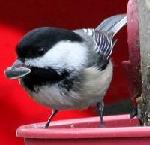
Chickadees like to grab a
sunflower seed from
a feeder and fly to a nearby tree to crack it open and eat
it. They hold the seed with their feet while cracking it
open with a few quick thrusts of their bill. It can be fun to watch them flying back and forth from tree to
feeder, and back again.
Many people are surprised to find out that
birds such as chickadees will eat out of your hand. If
chickadees are visiting your feeder, it often does not take
much to entice them to eat out of your hand. Let them
get used to seeing you stand by the feeder. Soon they
will take seeds from the feeder when you are there. Now
put some seeds in your hand and hold it out. Make sure
you stand still. After a while they will start landing
on your hand to grab the seeds.



 and Videos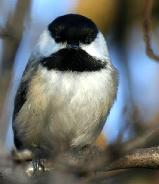
 Chickadees like to grab a
sunflower seed from
a feeder and fly to a nearby tree to crack it open and eat
it. They hold the seed with their feet while cracking it
open with a few quick thrusts of their bill. It can be fun to watch them flying back and forth from tree to
feeder, and back again.
Chickadees like to grab a
sunflower seed from
a feeder and fly to a nearby tree to crack it open and eat
it. They hold the seed with their feet while cracking it
open with a few quick thrusts of their bill. It can be fun to watch them flying back and forth from tree to
feeder, and back again.

 Get Chickadee posters

 baths, feeders
and more...
baths, feeders
and more...