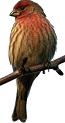
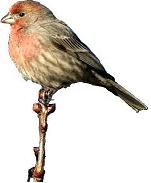
House Finch
Food such as sunflower seeds and water will attract
Finches to your
yard.
House finches were originally a resident of
southwestern U.S. In the 1940s called Hollywood finches
they were being sold illegally as pets. To avoid
prosecution venders, and owners released them into the wild and
the birds quickly spread across the country.
Identification and Pictures
House Finch (Carpodacus mexicanus) 5 to 6 inches
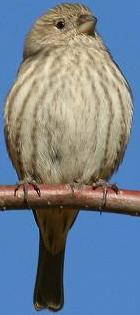
| House Finches have brown or grayish streaked back, and wings.
The breast is usually streaked with brown and white.
They have two white wing bars and a
short thick bill good for cracking
seeds.
Photos
by Keith Lee. The camera I use is the Canon
EOS 40D.
|
 |
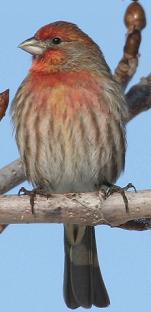 |
Males will have pink, red or sometimes
yellow on head, necks, shoulders, and rump. The male's
color will vary depending on their present diet. Females
prefer to mate with the reddest male they can find as
this indicates he could be a good provider for the
nestlings. |
Sound of House FinchTheir song is a lengthy cheerful
series of notes like "chee-wee" that shifts rapidly from low to high notes,
often ending in a nasal "che-urr". They will call
a single sharp "cheep" or "che-urr". The birds will sing while they are in flight as well as from perches.
Males have a longer song then the female.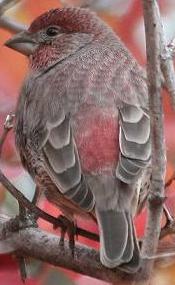
House Finch song:
Click for Sound
Click for Sound
Preferred Habitat
House finches can be found from southern Canada
through the U.S., and Mexico. They like deserts, orchards, and wooded areas, as well as cities, and residential areas.
They are a common bird at feeders all year long, often mixed in with other birds such as
sparrows, or chickadees.
Breeding and Nesting
During courtship is when you will most often
here the male's lovely warbling song. Male finches will bring bits of food to the female during courtship.
He may also feed her during incubation. Female House
finches build a cup shaped nest of twigs, and other vegetation. It can be in areas such as vines on the side of a build, or in a tree
cavity. If you have birdhouses they may nest in them.
The nest will often be use again the next year.
EggsFrom February through August the female will lay and incubate 2 to 6 smooth, pale bluish-green eggs with black spots on them. There are often two or more broods in a year.
In around 2 weeks the eggs will hatch. The young may be fed by both parents from 11 to 20 days. 2 to 6 smooth, pale bluish-green eggs with black spots on them. There are often two or more broods in a year.
In around 2 weeks the eggs will hatch. The young may be fed by both parents from 11 to 20 days.
Food and Feeding 
House finches eat mostly seeds, and berries but, will also eat insects. They forage through
vegetation, and on the ground, but are also a common visitor at bird feeders
through out the year. They are often mixed in flocks of birds such
sparrows, and chickadees that come to feeders with sunflower, and other seeds.
For more on food
and feeding click here.
For more on feeders click here.
To learn about other favorite
birds click here. | 




 baths, feeders
and more...
baths, feeders
and more...