Northern Mockingbird
Identification and Picture
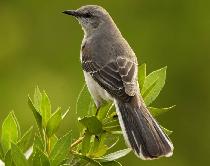
(Mimus Polyglottos)
photo by Hagerty, Ryan U.S. Fish and Wildlife
Mockingbirds are 9 to 11 inches about, the same size as a
robin, but a
bit slimmer. The birds are grayish above with a slight buff
color on the under parts. There are white patches on dark
wings, and tail. The wing patterns are conspicuous in flight,
and wing displays. Younger birds will be brown with spotted
breasts.
Several states claim this as their state
bird:
Arkansas, Florida, Mississippi, Tennessee, and Texas.
Song and Call – The Mimic
Northern Mocking birds got their name because
of their well-deserved reputation for imitating the songs, and
sounds of other birds. Mocking birds sing almost perfect
imitations of many other birds. Close to a third of its
singing will be imitations, which can include other sounds
such as machinery, sirens, frogs, other animals, or a human
whistling.
They sing a long succession of notes, and phrases, which will
be repeated several times, and then changed. The call phrases
can be imitations of songs of other birds. Other sounds are a
raspy chijjjand a harsh chewk. The male sings
in the spring, and both birds will sing in the fall. They will
often sing long into the night.
Sound 1
Sound 2
Range and Habitat
Mockingbirds can be found throughout most
U.S. all year. They like open land, forests, woodland edges,
roadsides, thickets, farms, and towns. Thick shrubbery in your
back yard will attract them. The birds establish two types of
territories. Individual male and female birds will have
separate feeding territories, which they will defend. During
breeding, and nesting a pair will claim a territory.
Breeding and Nesting
Breeding season is February to April
depending on the area.
They breed in open woodland, and country with scattered trees,
and shrubs.
In the spring the Mocking bird will clam its territory, and
defend it very aggressively. He does a type of aggressive dance wagging his tail
with raising, and lowering of wings. If his wing display doesn’t
work he will chase intruders. He will also chase females
until he chooses his mate.
He does a looping flight to, and from a chosen
perch, and sings to attract the female. Once they build the
nest they will aggressively defend it, dive-bombing any
creature that dares to come to close. This includes humans,
dogs, cats, and other wild animals.
The female picks the nesting site. The male will then start
by putting nesting material in her chosen location, and then
both birds will build the nest. The nest can be in a tree,
shrub or thicket. They build a bulky nest made of
twigs, weeds, leaves, string, rags, and other materials. The
inside is lined with fine grasses, plant down, moss, and hair.
The female alone will incubate 3 to 5 smooth glossy eggs.
Eggs can be pale blue, greenish blue, or pinkish blue, spotted
with reddish brown, or purple blotches. The markings will
usually be more intense near the large end. The young will be
tended by both adult birds, and can leave the nest within 2
weeks.
Food - Feeding and Water
Natural foods are all types of insects,
fruits, and berries. They forage on the ground, and will watch
from a perch, and fly down to grab an insect.
The best way to attract mockingbirds to
your backyard is to plant trees, and shrubs they might nest
in, those with fruits, and berries are best. Suggested plants
are hackberry, dogwood, mulberries, cherry, crab apples, and
others.
They will visit suet, and other feeders with fruit, raisins,
breads, and even seeds such as sunflower. Just like all
songbirds, water for drinking, and bathing will attract them,
especially if you have running or dripping water.
For more on food
and feeding click here.
For more on feeders click here.
To learn about other favorite
birds click here.

|



 baths, feeders
and more...
baths, feeders
and more...