Waxwings
 The best way to attract Waxwings to your yard is to have plants that have berries such as Holly or Hawthorn.
They also like a forest or wooded areas. The best way to attract Waxwings to your yard is to have plants that have berries such as Holly or Hawthorn.
They also like a forest or wooded areas.
Identification, Pictures and video
Cedar waxwings eating berries in juniper bushes
video above. For
other bird videos please visit our Youtube channel and
subscribe or like our videos.
Most videos on my site were taken with the Canon
HG10 camcorder.
There are three species of waxwings.
Cedar and Bohemian waxwings are found in North America and the
third species, the Japanese waxing is found in eastern Asia.
Cedar Waxwings (Bombycilla cedrorum)
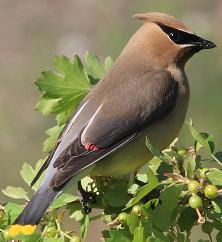
Cedar Waxwings are sleek golden brown birds a
little larger than a sparrow about 6 1/2 to 8 inches in
length. Their fluffy soft feathers
almost look like fur. The fawn colored plumage blends
into an ashy gray.
Waxwings get their name from the red teardrops
at the tip of the secondary wing feathers. The drop
which looks like red wax can be seen on most adults.
Sometimes it will also be on tail feathers.
Photos by Keith Lee.
The camera I use is the Canon
EOS 40D.
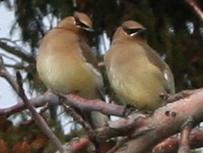 The breast will sometimes
be a yellowish color. Both sexes look alike. They have a head crest,
much like Cardinals
or Blue Jays. There is a yellow
band at the tip of their tail, and under tail coverts are
white.
The breast will sometimes
be a yellowish color. Both sexes look alike. They have a head crest,
much like Cardinals
or Blue Jays. There is a yellow
band at the tip of their tail, and under tail coverts are
white.
 There is a
black patch or mask that starts above the eyes, and crosses over above the beak. This short beak is slightly hooked, to help it easily pick berries,
and catch small insects. Waxwings like many birds have specialized
beaks.
There is a
black patch or mask that starts above the eyes, and crosses over above the beak. This short beak is slightly hooked, to help it easily pick berries,
and catch small insects. Waxwings like many birds have specialized
beaks.
Young birds are more of a gray color
with light streaks on the under parts. Instead of a the black mask
the adults have, young birds have white on their cheeks, and
behind their eyes
Bohemian Waxwings (Bombycilla Garrula)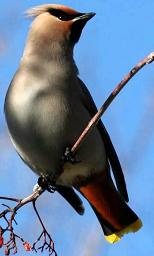
Bohemian Waxwings are similar to the Cedar Waxwing
but a bit larger. They have a rusty crest, and face, but
are more of a gray color, with no yellow on the belly.
Bohemian's have white, and yellow markings in the wing and tail
feathers have yellow tips. Under tail coverts are a deep,
rusty color.
Photo by Keith Lee. The
camera I use is the Canon
EOS 40D.
Phainopepla (Phainopepla nitens) 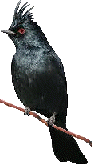
Although waxwing like bird has a similar
shape they have
none of the coloring Cedar waxwings do. Males are
shiny black and females are more of a gray color.
Song and Calls
Most of the time waxwings are not heard. The song is a quiet,
high-pitched hissing whistle. This is often given when
they are in flight or are just taking off. It sounds
something like seee.
When perched they can be heard giving a light
cricket like call, and high bzeeee trill.
Sound 1
Sound 2
Range and Habitat
In the summer waxwings can be seen across Canada,
and the Central U.S.
They are in the pacific northwest, central and northeast U.S.
all year long, and will stay in woodlands, orchards, and open
areas where there are trees, and shrubs with berries.
They like to spend the winter in the southern half of the U.S.
Breeding and Nesting
In late spring males can be seen hopping
around doing their courting dance. During breeding
season they will feed in flocks. Males will also pass
berries to females. If a female is interested she will
dance with the male. The two birds will hop from side to
side and pass a berry back and forth. This will go on to the end of summer.
The female will choose a nest site. The nest is a
bulky structure of grass, leaves,
fibers, bark, twigs, and moss. They will use bits of
string or cloth set out by people.
Waxwing Eggs 
The female will lay three to six pale bluish gray eggs, with dark
markings. She will incubate the eggs for 10 to 12 days.
During this time the male will stand guard and bring her
food. Both parents feed the chicks which fledge in about two weeks.
Adults store food for the young in a crop or pouch located in the
throat.
Food and Feeding
Waxwings love fruit, their favorite being berries.
If you have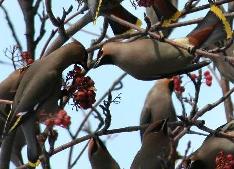 trees, and shrubs with berries on them you may see large flocks of
these extremely social birds. Waxwings will fly in
and stay as long as the fruit lasts, then they will be gone.
Often the birds eat fermented berries, and become intoxicated.
trees, and shrubs with berries on them you may see large flocks of
these extremely social birds. Waxwings will fly in
and stay as long as the fruit lasts, then they will be gone.
Often the birds eat fermented berries, and become intoxicated.
They will also eat insects, which provide a good protein source especially during breeding season.
Photo by Keith Lee. The
camera I use is the Canon
EOS 40D and a 70 to 300 zoom lens.
Waxwings will eat raisins or sliced fruit such as apples or oranges.
For more on food
and feeding click here.
For more on feeders click here.
To learn about other favorite
birds click here.

|



 baths, feeders
and more...
baths, feeders
and more...