Bird Intelligence 
We have all heard someone called birdbrain or
featherhead, indicating they were dim witted or brainless.
As it turns out birds have gotten a bum rap. When compared to
other animals some birds are actually pretty smart. A good example is
corvids or the crow family. In the Audubon
Society of Encyclopedia of North American Birds,
ornithologist John K. Terres says corvids have achieved the
highest degree of intelligence of any birds. Irene Pepperberg
know for her studies in animal cognition writes that corvids
cognitive abilities are equal to many primates such as chimps
and gorillas
There is a little disagreement over just
which one of this family is the smartest. Some say the
American crow is at the top of the list, others say it is the
raven and still other say jays or jackdaws. Whoever is
right, it is agreed that Corvids are smart.
Some say mynas and parrots are just as intelligent, if even a
little brighter. Everyone is familiar with the ability to
mimic songs, calls and other sounds
many birds have, but they can do more than that.
There is one study of a parrot that was able
to identify more than 100 items by name. In addition the bird
could also tell similarities and differences. If shown 3
triangles of different colors and asked what is the same or
different the bird would give the correct answer (shape or
color) four out of 5 times. Birds such as nutcrackers
will hide thousands of seeds, and remember where they stored
them as much as nine months later.
Learning Ability
Some say birds are nothing more
than living robots, with every thing they do programmed into
their genes from birth. There is evidence however that
suggests that while this is true, certain birds have advanced
learning abilities. For instance some birds such as
jackdaws
do not automatically recognize what animals are predators.
They learn it from their parents. Many songbirds are
able to learn and teach vocal communication, the skill which
makes human language possible. Studies have shown
that nuthatches learn and understand the calls of
chickadees. When chickadees announce the presents of a predator,
nuthatches will join with them to mob and chase away the predator.
Research by psychologist Helmut Prior shows that magpies have
self-recognition, a trait previously thought to only exists in
higher orders of mammals. The researchers placed colored
dots on the necks of magpies. When the birds saw the
dots in a mirror they would try to remove them.
Bird Brains
The cerebral cortex is the main area of
intelligence for most animals. Birds have a relatively small
cortex. In the 1960s neurologist Stanley Cobb discovered that
birds use a part of the brain, which mammals do not have, as
their main area of intelligence. This is the hpertriatum, and
is at the front of a bird’s brain. It was found that the
larger this part of the brain was the better birds did on
tests to measure intelligence.
Not surprisingly Corvids are the group of birds where
this is the largest. In fact their brain to body ratio
equals that of dolphins and is almost the same as ours.
Social Behavior a Sign of Intelligence
Scientists say the more social animals are
the smarter they tend to be. Aside from humans and other
primates, dolphins and whales are at the top of this list.
Parrots and corvids are also highly social.
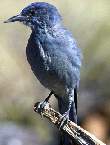 John Marzluff and Russell
Balda studied Pinyon jays and charted their genealogy. Pinyon
jays live in troops, which consist of many clans. In the fall
the troops will congregate into flocks of thousands of birds.
Later they will again separate into the original clans. John Marzluff and Russell
Balda studied Pinyon jays and charted their genealogy. Pinyon
jays live in troops, which consist of many clans. In the fall
the troops will congregate into flocks of thousands of birds.
Later they will again separate into the original clans.
Pinyon Jay photo by Dave Menke US Wildlife
Corvids, such as crows, ravens, and magpies may separate into a
family group for things like nesting and territory defense,
and then congregate into huge flocks. These flocks, which may
include a variety of birds such as crows, Magpies, and
Jackdaws, can get huge. There are sites in central U.S. that
get flocks, which are estimated to be as many as 10 million
crows.
Intelligence experts say this kind of social interaction
requires superior intelligence. The reason is that for this
to happen the birds must not only be able to recognize, and
remember companions, but must also be able to notice, and
interpret small changes in appearance and behavior.
Play and Games
Yes birds are even known to play games, and
even intentionally tell lies. Examples of games played are drop and catch where one bird
will drop a stick another will catch it. If one bird hangs
upside down and passes an object form its feet to its beak
and back again others are likely to do the same thing. This
shows the ability to learn behaviors. One game played is
where a bird will stand on a mound, and hold a stick while
another tries to take it from him.
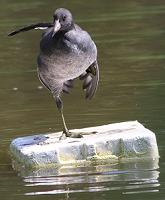 I
once observed a coot playing on a foam box top. It
started with two other coots pushing him around. When
the other birds tired of this, he continued on his own.
The coot would flap his wings to get the top moving
forward. He would then ride the top, standing on one leg
until it stopped. When it stopped he would start
flapping again. He repeated this process many times. I
once observed a coot playing on a foam box top. It
started with two other coots pushing him around. When
the other birds tired of this, he continued on his own.
The coot would flap his wings to get the top moving
forward. He would then ride the top, standing on one leg
until it stopped. When it stopped he would start
flapping again. He repeated this process many times.
Teamwork
Some birds will cooperate while hunting.
An
example is what could be called bait and switch. Two or more
birds discover another animal with something they would like
to eat. One bird will land, and distract the animal maybe by
pecking at its tail. As soon as the animal turns the other
bird swoops in and takes the food. There is even
teamwork between species, an example is birds such as chickadees
and nuthatches working together to
drive away a predator.
Use of Tools
Obviously they use material to build nests
but it goes beyond that.
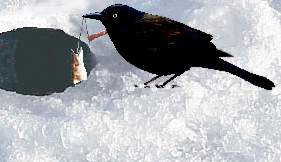
Crows have been known to steal fish from ice fishermen by
using their beaks and feet to pull up the lines when the men
were not looking.
Some birds have been observed using twigs to
probe for grubs they could not reach. They may even use a bit
of invention by bending or shaping the twig for this purpose.
Even more fascinating are some types of birds
that seem to use bait for fishing. In this instance they will
drop an insect in the water and wait for a fish to surface.
Some birds such as jays will wedge a nut into forked branches to make it easier
to crack. American crows have been observed dropping rocks or
holding them in their beaks while they pound on nuts to open
them.
Crows in Japan have an interesting way of
cracking nuts. They will wait at a traffic light.
When the traffic stops they will run out an place a nut in
front of a car tire. When the traffic stops again they
will retrieve their cracked nut. View
video
Honeyguide
African honeyguides are small birds named for
their habit of leading people to bee hives. The birds
will call and fly backwards to get the people to follow
them. After the
people open the hive and retrieve the hone the birds feed on
the left over honey and larvae.
Please Pass the Ant
Birds often clean their feathers, one good use of a
birdbath. This preening as it is called, both cleans and
repairs the feathers so they are better for flying and
insulation. It also helps fight parasites. Most birds will
spread oil form the preen gland during this process.
Some do what is called Anting. This is where they
pick up an ant, and rub it through their feathers, or even sit
in ants. It is thought that the formic acid from ants works
as a repellent for fleas and lice.
Where did I put that?
In experiments jays have been shown to
remember exactly where they hid acorns. In one study
jays
were able to find seeds almost a year after they hid
them. It is thought that they remember these by forming,
and storing detailed image maps of the surrounding area.
This page scratches the surface. If you are interested in
more on the brains and intelligence of birds I suggest
reading Bird Brains by Candace Savage.
Learn about
favorite backyard birds.
More about Parts and
Anatomy of a Bird.

|



 baths, feeders
and more...
baths, feeders
and more...